
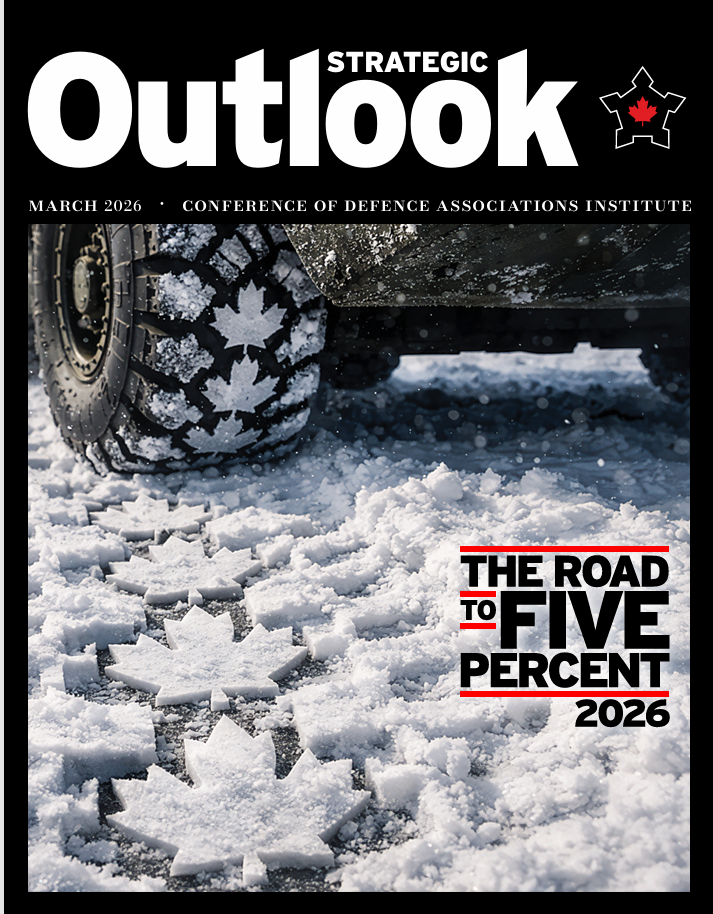
Now in its 94th year, the Ottawa Conference on Security and Defence is Canada’s premier defence and national security forum. This year’s theme, The Road to Five Percent, reflects a defining moment in Canada’s history. The federal government’s commitment to increase defence spending to five percent of GDP over the next decade will have far-reaching implications for the size, structure, and readiness of the Canadian Armed Forces (CAF), as well as for our country’s economy and the future of Canadian society.
The increased investments come at a time of heightened geopolitical tension for Canada and its allies. Great power competition and hostile threats both above and below-the-threshold have placed immense pressure on Canada to safeguard its sovereignty and defend the population. For the first time in decades, the overlap between economic security and national defence is deeply intertwined—underscoring the need for greater strategic autonomy.
Over the last few months, the defence community has sought to seize the moment by ensuring the right capabilities and equipment are acquired in a timely and efficient manner. At the core of this effort is the Defence Industrial Strategy’s BUILD-PARTNER-BUY framework, which aims to strengthen Canada’s industrial base by expanding domestic production, cementing existing and forming new trading relationships beyond the United States, and acquiring off-the-shelf capabilities when necessary. Canada’s defence investments are intended not only to secure an operational advantage over our adversaries, but also to stimulate economic growth and prosperity from coast to coast to coast.
It is in this context that we present the Strategic Outlook. This volume brings together seven short essays authored by leading voices from across Canada’s defence and security community. Each article touches on a different domain that will impact Canada’s defence trajectory in the years ahead.
The volume opens with Fen Hampson examining Canada’s “middle power trap” arguing the country faces a double burden: hegemonic tax from U.S. dependence and a geopolitical tax from trade diversification. Jessica West takes on the space domain, contending that Canada’s security in orbit depends not on dominance, but on resilience, sustained access, and disciplined risk management. The volume then turns to Kate Todd, who assesses the shift from maritime cooperation to contestation in regions such as the Taiwan Strait, Red Sea, and Arctic, arguing that Canada’s aging fleet and limited capacity leave us ill-prepared to defend our interests. Nicholas Glesby focuses on the air domain, looking specifically at next generation missile threats, arguing Canada should become a full and credible partner in the U.S.’ Golden Dome initiative. On the land domain, Howard Coombs writes about lessons learned from the Russia-Ukraine War and highlights the importance of adaptive military institutions, resilient logistics, and whole-of-society defence for Canada and its allies. Grey-zone or below the-threshold threats are captured by Dani Belo who unpacks how society, cyber, and economic vulnerability intersect with competitive multilateralism, suggesting resilience and strategic coalition-building are key to successfully deter our adversaries. Finally, Kristen Csenkey concludes the volume with a discussion on Canada’s cyber and technological defence challenges, focusing on AI, quantum risks, and the need for resilience and allied coordination in 2026.
Together, these essays make an important contribution in enhancing public literacy, provoking thoughtful debate, and serving as a complementary scene-setter for the substantive discussions set to take place at the Ottawa Conference.
As Canada forges ahead with historic levels of defence investment, rigorous strategic thinking is essential to ensure that those investments are coherent, effective, and aligned with our enduring national interests. The CDA Institute remains committed to being Canada’s preeminent leader in defence thinking—connecting stakeholders across the country, convening events such as the Ottawa Conference, and contributing to the national dialogue through rigorous, evidence-based research and analysis.