
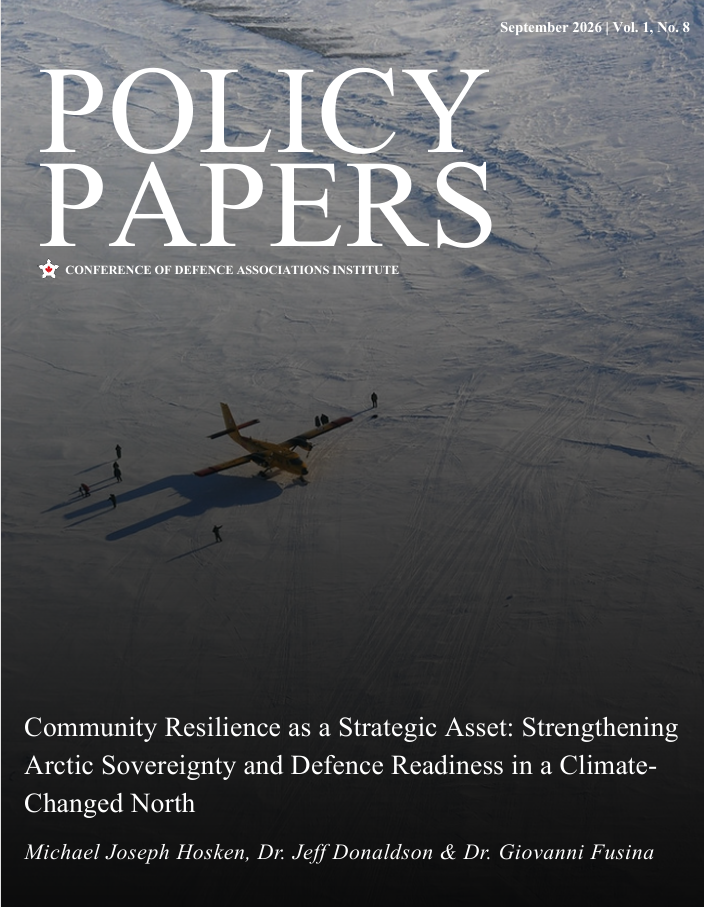
Canada’s North is warming far faster than the global average, and the resulting coastal erosion, flooding, permafrost thaw, and wildfires are outpacing the civilian systems meant to manage them. Federal response has increasingly defaulted to the Canadian Armed Forces (CAF): Operation LENTUS activations have broadly doubled every five years since 2010, and the CAF has shifted from last resort to routine backstop. This dependency is a defence and security problem, not only an emergency management one: repeated military substitution imposes readiness and opportunity costs while suppressing the local capacity that most determines disaster outcomes.
Drawing on disaster research, parliamentary and departmental evidence, Nordic total defence practice, and Canadian Arctic policy sources, this paper treats community-level resilience as a strategic asset: in the Arctic, everyday presence sustains jurisdiction more durably than episodic demonstrations of force. It assesses the hazard landscape, the limits of the current approach, the contribution of social capital and Indigenous leadership, and available science and technology enablers, then adapts Nordic total defence lessons to Canadian geography, federalism, and reconciliation commitments. It sets out seven five-year recommendations: strengthen hazard monitoring and adaptive infrastructure; rebalance the CAF’s role through a whole-of-community surge mechanism; invest in Indigenous-led resilience hubs and governance; strengthen social capital and volunteer networks; expand community access to locally usable science and technology, with improved connectivity and digital literacy; improve coordination through a northern-focused governance mechanism informed by Nordic practices; and sustain sovereignty by investing in housing, services, and stable population presence.